
Group Show Artists
-

Aditi Patwari
Aditi Patwari is an India-born textile artist and designer whose multidisciplinary practice spans textiles, design, marketing, and international business. Working through weaving, surface design, and material-led experimentation, she explores duality, shifts between inner and outer worlds, and the deconstruction and reconstruction of cultural and architectural vocabularies. Her works translate lived experiences into layered textile forms, reflecting an ongoing process of internal globalization shaped by her movement across India, the UK, and the UAE. Rooted in a study of diverse lifestyles and philosophies, her practice examines how shared aesthetics and lived experience can create connective cultural space.
Aditi holds a BA (Hons) in Textiles from Arts University Bournemouth and an MSc in International Business from Hult International Business School. In 2019, she founded her bespoke textile brand Dea, which also embodies her artistic identity. She has exhibited across the UAE, US, UK, Germany, Italy, China, and Singapore, and her work has been featured in Harper’s Bazaar Art, Architectural Digest ME, The National AE, and Khaleej Times. She is currently engaged in research on cultural formation and the connective potential of shared aesthetic systems.
-

Aman Kumar Bavariya
Aman Kumar Bavariya is a Jabalpur-based painter whose practice draws from the rhythmic logic of weaving to explore memory, labour, and domestic life. Working primarily with acrylic on canvas, he builds finely layered brushstrokes that echo the tactile qualities of handwoven fabric, an influence rooted in childhood memories of his grandmother’s craft. Rugs, doormats, female figures, and everyday household objects appear as recurring motifs, transforming rural and domestic references into intimate visual meditations on care and embodied knowledge.
Aman holds an MFA in Painting from the Government College of Fine Arts, Jabalpur (2025). His work has been exhibited at the Kochi Students’ Biennale (2025), Method Gallery, and Space Studio. He is a recipient of the Kala Sakshi Art Scholarship (2024) and the MAIR Residency, and his paintings are held in collections across Mumbai, Delhi, and Vadodara.
-

Ayantika Sajwal
Ayantika Sajwal (b. West Bengal) is a visual artist based in Baroda whose practice spans clay, metal, leather, and hybrid sculptural processes. Drawing from the material-centred ethos of Shantiniketan and the industrial, multidisciplinary environment of Baroda, she explores memory, rupture, and the body as a site of vulnerability and endurance. Her sculptural language emerges through tactile experimentation, where material behaviour becomes a way to reflect on personal and collective histories.
Ayantika holds a Bachelor’s degree in Ceramics and Glass from Kala Bhavana, Shantiniketan, and a Master’s in Sculpture from The Maharaja Sayajirao University of Baroda. She has exhibited at Bikaner House, Exhibit 320, and Conflictorium, and is represented by Studio Catalyst. She is a recipient of the Maati Foundation Scholarship, the Kala Sakshi Grant, and several artist residencies.
-

Dhruv Poddar
Dhruv Poddar (b. 1999, Assam) is a multidisciplinary artist based in Vadodara whose practice draws from the cultural and ecological landscape of Guwahati. Working across sculpture, installation, painting, video, photography, text, and found objects, they examine power, marginalisation, and ecological collapse through satire, symbolism, and playful critique. Childhood materials, games, toys, learning tools, recur as conceptual devices, shaping immersive environments that probe social and political realities with disarming clarity.
Dhruv holds degrees in Animation & Multimedia (2020), a BVA in Sculpture (2023), and an MVA in Creative Sculpture (2025), all from MSU Baroda. Their work has been exhibited at Dhoomimal Gallery and Triveni Kala Sangam. They are a recipient of the Jeram Patel Award, the Shri Babubhai Jashbhai Patel Gold Medal, the Hyundai Art for Hope Grant (2024), and were a finalist for the Global Art Awards (2018).
-
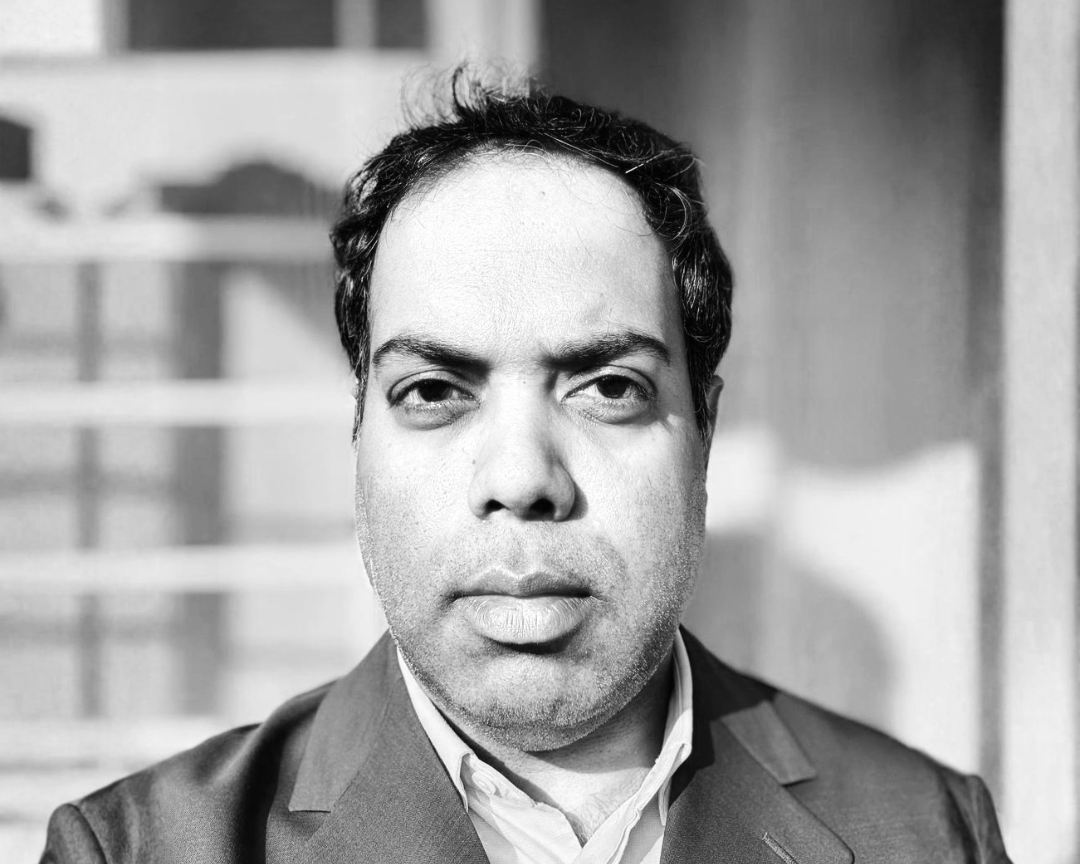
Naveed Vali
Naveed Vali is a visual artist and photographer whose practice investigates ideas of place, memory, and perception in an image-saturated world. Through his ongoing project Nowhere That I Know, Vali documents locations across India, Europe, the United States, and the Middle East that appear familiar yet resist precise identification. His work reflects on how travel, technology, and social media have altered our relationship with geography—where places are consumed as images and remembered as impressions rather than destinations. Working through carefully composed photographic series, he explores themes of anonymity, recognition, and the quiet dislocation of contemporary experience.
-

Parth Itwala
Parth Itwala (b. 2001, Vadodara) is a visual artist whose practice explores shifting urban landscapes through memory, displacement, and socio-political change. Trained in Painting at the Faculty of Fine Arts, MSU Baroda (BVA 2023, MVA 2025), he reflects on Baroda’s rapidly transforming cityscape, particularly the impact of the Smart City Project, through photo documentation, montage, collage, and image-transferred painting. His works emerge from walking, cycling, and collecting, weaving found objects, popular culture, and text into layered visual narratives shaped by nostalgia, rupture, and absence.
Parth has exhibited at Abir India First Take, Ecriture, Pristine, and in the Nasreen Mohamedi Scholarship displays. He was a 2024 Kala Sakshi artist-in-residence and is a recipient of the Nasreen Mohamedi Scholarship. He is represented by Studio Catalyst by Anant Art.
-

Ridam Kumar
Ridam Kumar is a sculptor from Motihari, Bihar, whose practice explores migration, surveillance, movement, and illusion through kinetic form. Currently pursuing a Bachelor’s in Sculpture at the Faculty of Fine Arts, Maharaja Sayajirao University of Baroda, he draws on personal memories, long train journeys, and the emotional terrains of displacement to build intimate mechanical worlds.
Rooted in a lifelong fascination with flight and simple engineering, Ridam constructs kinetic sculptures that merge traditional craft with accessible technologies. Working with wood, papier-mâché, ceramic, brass, and electronic components, he creates subtle gestures, tapping feet, flapping oars, shifting eyes, that open deeper narratives of longing, observation, and identity. His works transform everyday objects into metaphors of burden, connection, and the invisible movements that shape human experience.
-
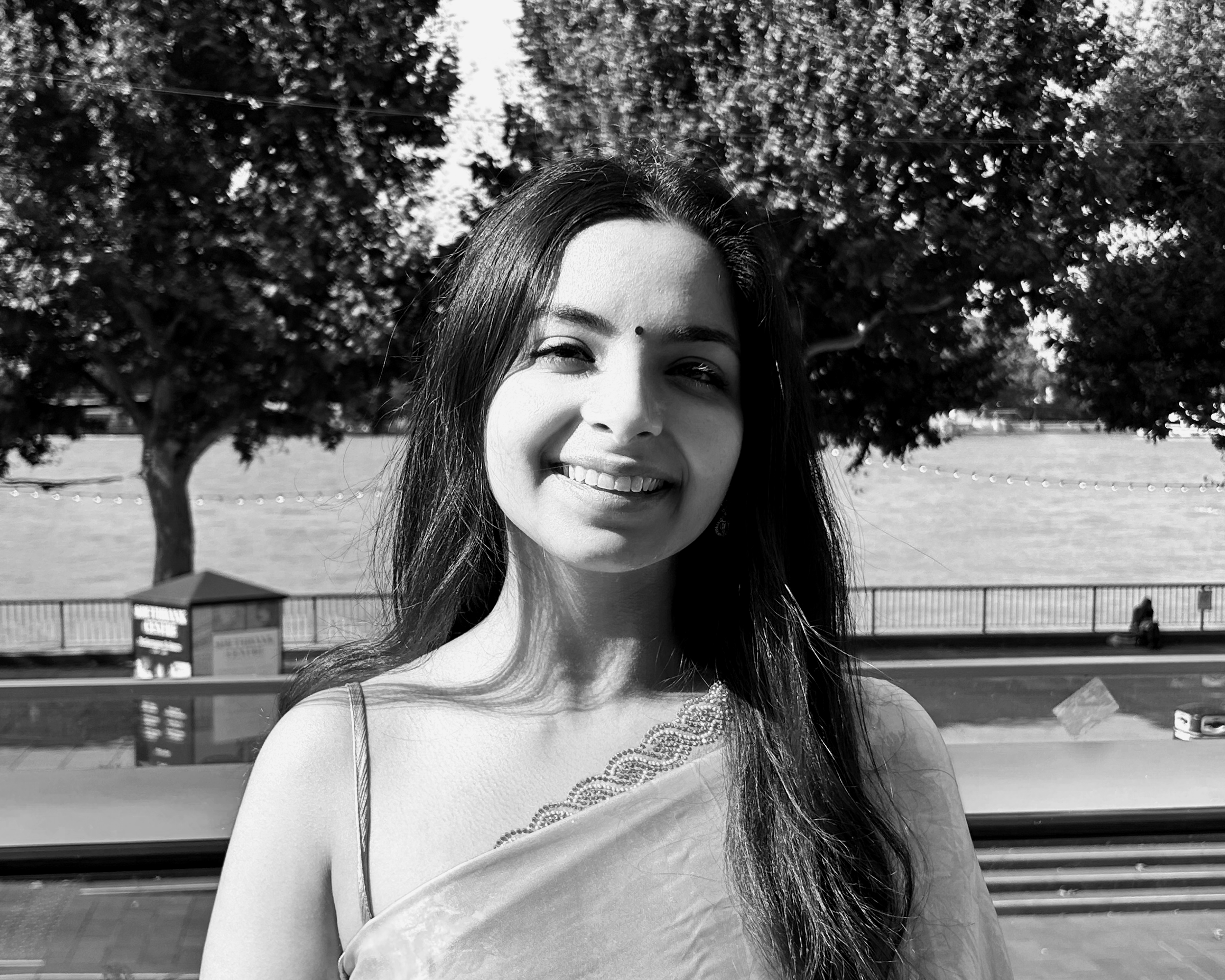
Riya Bhagat
Riya Bhagat is an experiential designer and multimedia artist whose practice explores care as both method and mindset. Working at the intersection of biology, design, and storytelling, she creates speculative narratives and participatory experiences that invite audiences to imagine new rituals of environmental and material connection. Her work constructs symbiotic futures within more-than-human ecosystems, often reframing extractive systems through imaginative world-building and material experimentation.
Riya holds an MA in Information Experience Design from the Royal College of Art. Drawing from nature, heritage, and everyday rituals, she develops multimedia installations and workshops that examine evolving relationships between humans, technologies, and the non-human world. With a background spanning communication, set, and museum design, her practice moves fluidly across mediums. Her work has been exhibited internationally across museums, film festivals, and cultural institutions, positioning her as an emerging voice in speculative design and material futures.
-
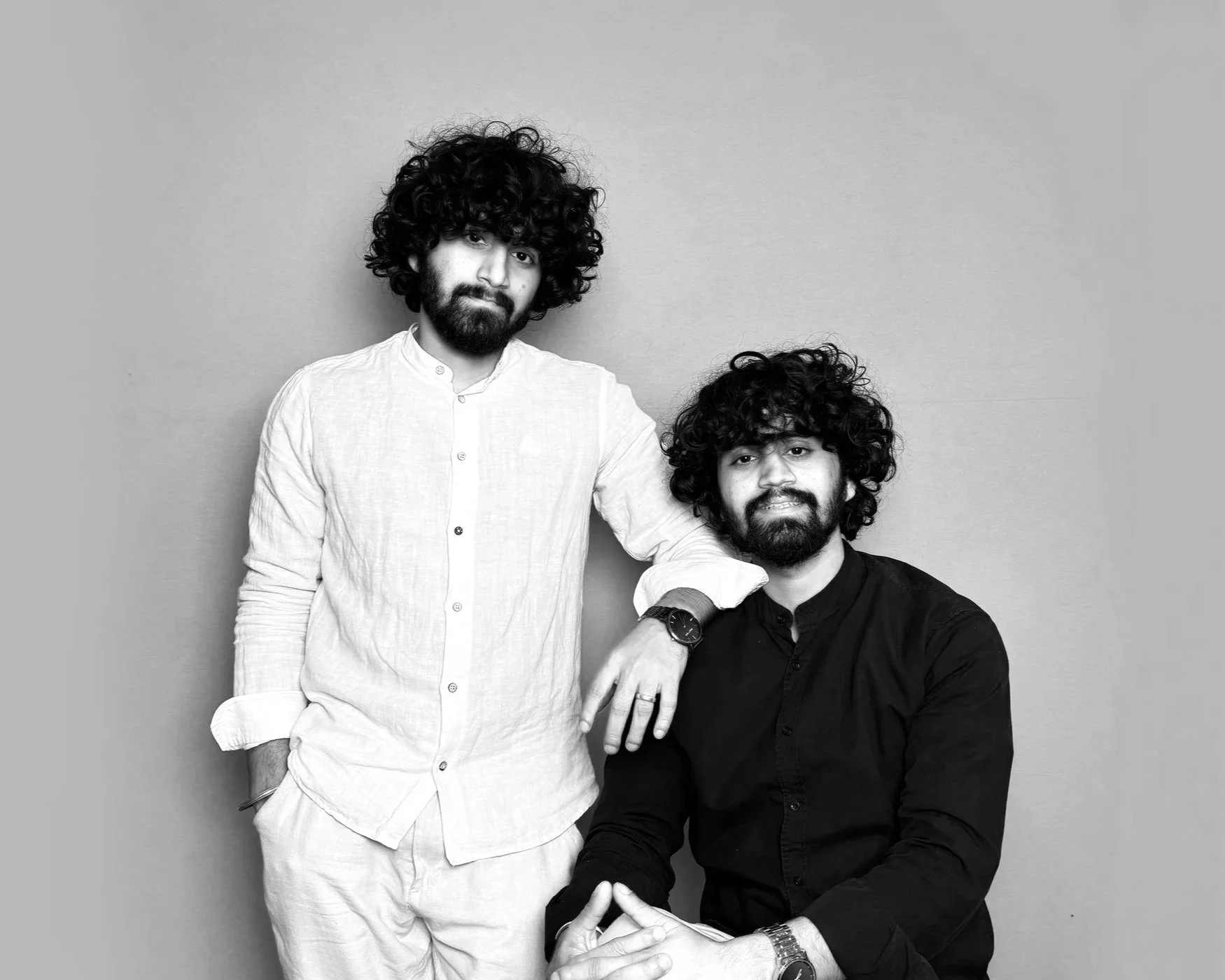
Roshan and Rohan Anvekar
Roshan and Rohan Anvekar are multidisciplinary twin artists whose collaborative practice navigates the relationships between self, society, and the cosmos. Working across painting, drawing, sculpture, installation, and mixed media, they construct surreal metaphors and symbolic narratives drawn from everyday life, nature, mythology, and philosophical inquiry. Their shared visual language blends introspection with social critique, creating poetic spaces that reimagine contemporary experience.
Rohan holds a BFA and MFA in Creative Painting from Sir J.J. School of Art, Mumbai, while Roshan completed his BFA at Sir J.J. Institute of Applied Art and his MFA in Painting at IKSV, Khairagarh. Their work has been exhibited at Galleria Nvya, Triveni Kala Sangam, Travancore Palace, and the Korea Art Biennale, among others. They are recipients of the Amar Nath Sehgal Grant and multiple national awards.
-
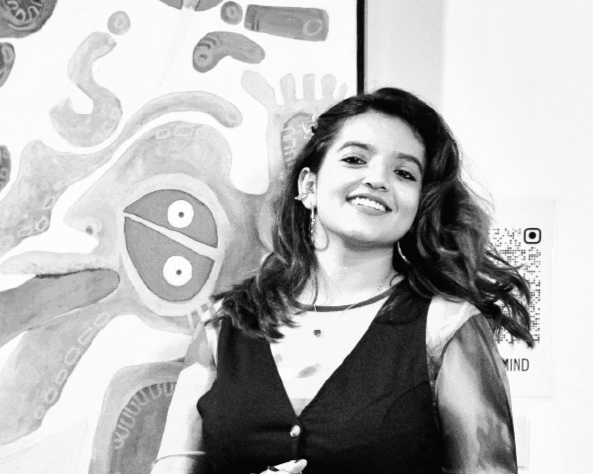
Shagun Agarwal
Shagun Agarwal is a multidisciplinary artist and psychologist whose practice unfolds at the intersection of emotional inquiry and creative expression. Rooted in introspection, her work explores the shifting inner landscapes of the mind—memories, sensations, and internal movements that shape identity. Drawing from insight and intuition, her art often begins as a feeling before resolving into form, allowing meaning to emerge gradually. Her work treats creativity not as an outcome, but as a process of conscious exploration—one that encourages viewers to look inward with softness, curiosity, and courage, embracing change as an essential part of becoming.
-

Sumit Naik
Sumit Naik is a contemporary figurative artist based in Corlim, Goa, whose practice bridges the structural possibilities of paper with the emotional depth of hyperrealism. Working primarily with charcoal on meticulously crafted paper forms, he folds, cuts, and shapes the material into architectural frameworks that act as the foundation for his intimate figurative drawings.
Influenced by urban architecture and spatial memory, Sumit creates surfaces where abstraction meets realism, allowing the paper to function as both structure and metaphor. Through meditative layers of charcoal, he captures fleeting emotions and vulnerable inner states with striking clarity. His works invite viewers into quiet, contemplative encounters that reveal the nuanced complexities of human experience.
-
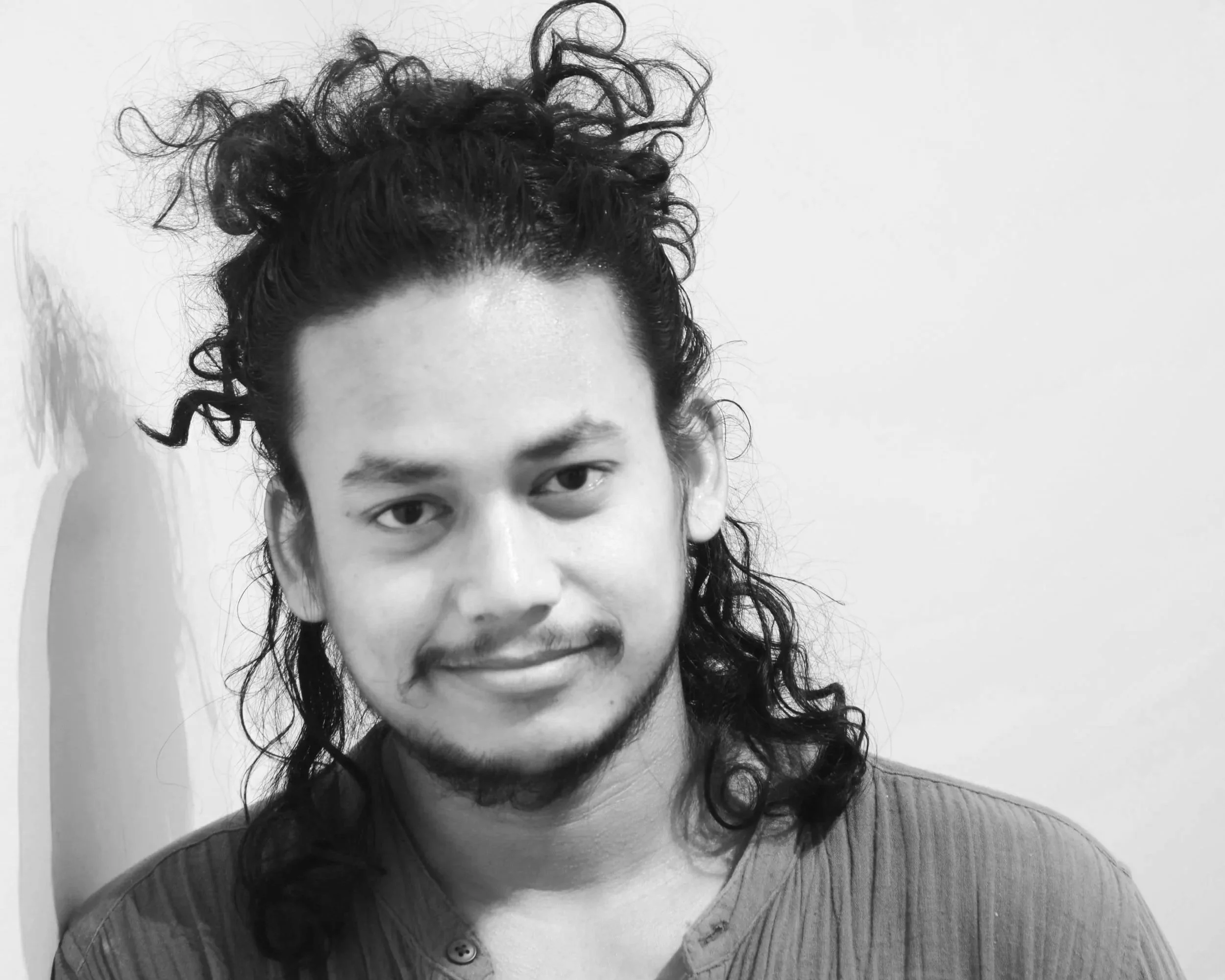
Subhash Deka
Subhash Deka (b. 1997, Sarthebari, Assam) is a sculptor whose practice is rooted in the cultural and natural rhythms of his upbringing. He draws inspiration from the subtle movements of the environment, swaying banana leaves, shifting winds, changing rain patterns, translating these fleeting sensations into sculptural form. His work blends observation, memory, and material sensitivity, often echoing the sensory landscapes of Sarthebari and the quiet intimacies of rural life.
Subhash holds an MFA in Sculpture from Indira Kala Sangeet Vishwavidyalaya, Khairagarh (2023), and a BFA in Sculpture from Kokrajhar Music and Fine Art College (2021). Through his sculptures, he invites viewers into contemplative spaces where nature, nostalgia, and cultural connection merge.
-
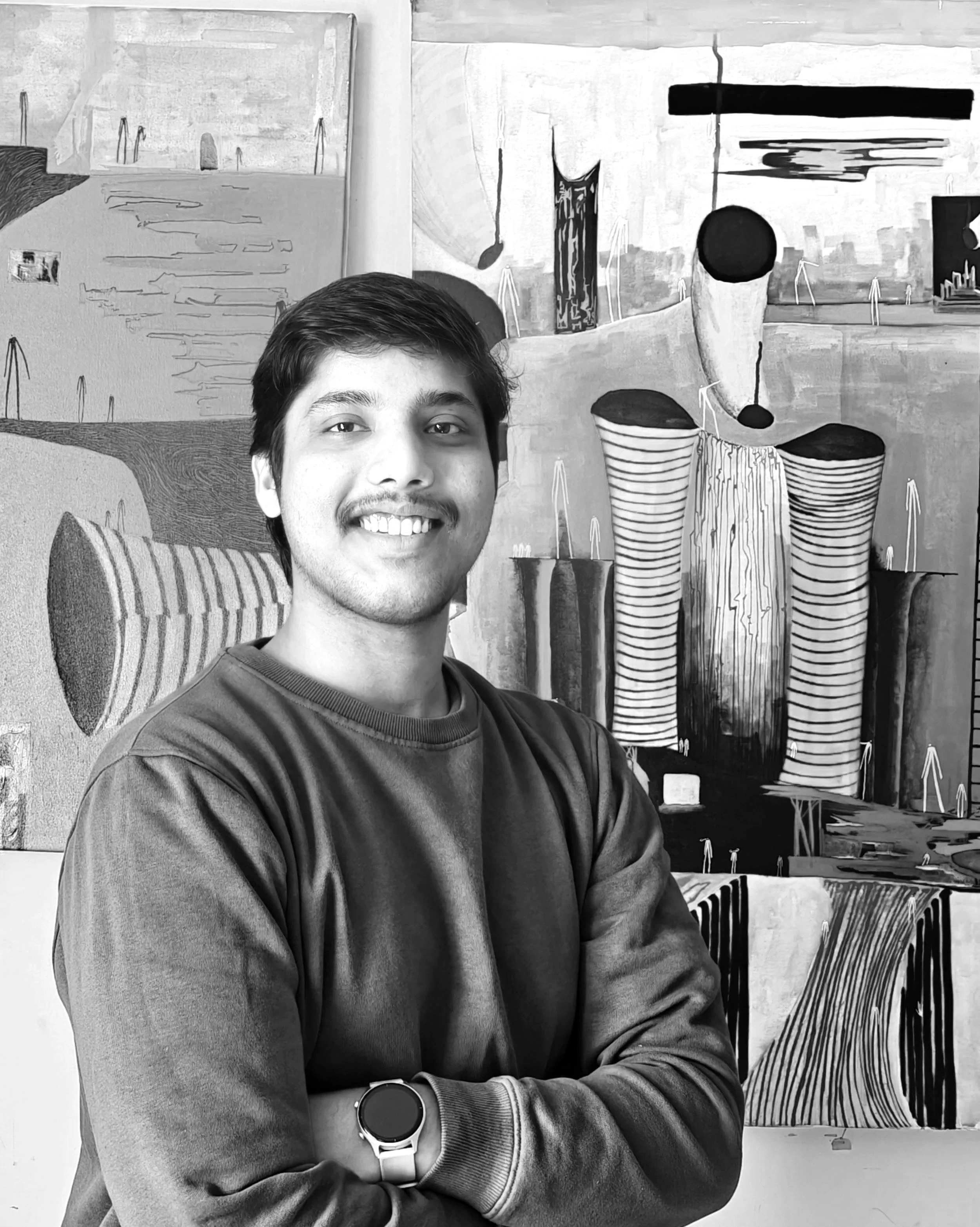
Yash Choudhary
Yash Choudhary is a visual artist from Jaipur whose practice emerges from the sensory and emotional textures of urban life. Transforming everyday city moments, traffic, fading architecture, shifting crowds, and familiar street rhythms, into expressive abstractions, he works through memory and sensation rather than direct representation. Using fractured geometric forms, bold colour juxtapositions, and intuitive mark-making, Yash reflects on Jaipur’s evolving identity, a place he characterises as a “dystopia after the utopia,” where tradition and modernity continually collide.
Rooted in close observation, his non-representational compositions reimagine ordinary scenes, pre-dawn fog, street corners, discarded objects, into visual metaphors for change, alienation, and connection. His paintings offer a poetic and critical reflection on the contemporary city and its shifting emotional undercurrents.
-

Yashika Goel
Yashika Goel is an interdisciplinary artist and designer whose practice interrogates the systems shaping emerging technologies while imagining subversive futures. Working across new media, code, installation, sound, film, and sculpture, she creates experiential narratives that explore how human and non-human identities are entangled within today’s technological paradigm. Rooted in feminist thought and community-driven methodologies, her work develops participatory frameworks that question algorithmic bias and propose alternative modes of making and experiencing AI.
Her graduate project Machine Yearning (2024) embodies this approach through an AI model that generates meaning from shared stories of female yearning, disrupting conventional machine-learning systems through intimacy and oral histories. A Lumen Prize Finalist (2025), the work has been exhibited at the Victoria and Albert Museum, Peckham Digital, and the Royal College of Art. Her broader practice has shown internationally across museums, festivals, and cultural institutions.